






Introduction
In the world of electronics testing, efficiency and precision are the twin pillars of progress. For decades, engineers had to juggle multiple discrete instruments just to characterise a single component. However, as components continue to shrink and power efficiency becomes paramount, these traditional testing setups often fall short. Enter the source meter: a powerhouse instrument that condenses multiple capabilities into a single, highly synchronised device. This article explores why these precision devices are now considered the indispensable, all-in-one solution for modern electronics testing.
What are Source Meters? Basic Definition & Core Features
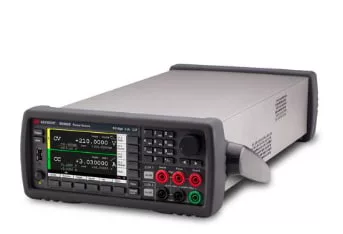
A source meter, also referred to as a source measure unit (SMU), is a high-precision electronic instrument engineered to source and measure a range of electrical quantities. Unlike traditional test and measurement instruments that perform only one function, an SMU integrates multiple test functions into a single, powerful unit. At its core, source meters can source (supply) voltage or current while simultaneously measuring voltage, current, and resistance.
The core features of a modern SMU include high-resolution sourcing, four-quadrant operation, and high-speed data acquisition. Because the sourcing and measuring circuits are tightly coupled, the instrument can automatically adjust its output to maintain precise control over the device under test (DUT), even under varying load conditions. For ease of use, most units feature a touch-and-test interface that allows engineers to plot I-V (current-voltage) curves directly on the screen.
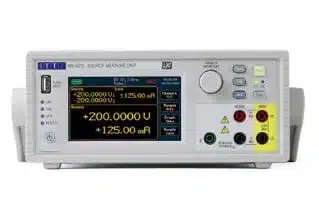
The Significance of Source Meters in Modern Electronics Testing: Why Do They Matter?
Modern electronics testing demands accuracy, repeatability, and efficiency. Devices like IoT sensors, wearable tech, and advanced transistors operate on minuscule amounts of power, leaving very little room for error. Source meters matter because they reduce measurement uncertainty by consolidating power sourcing and measurement into a single unit. By eliminating the need for multiple instruments and complex wiring, these devices significantly reduce errors caused by lead resistance, timing mismatches, or signal noise.
Furthermore, beyond precision, source meters are significant in protecting delicate components. With programmable compliance limits, they prevent overvoltage or overcurrent conditions that could otherwise destroy a device during a test. This level of control is indispensable in semiconductor testing, research laboratories, and quality assurance environments.
Core Capabilities of a Source Meter Explained: A Brief Overview
A source meter is defined by its ability to multitask with extreme precision. It operates as a unified system rather than a collection of separate parts. Some of its core capabilities include:
Four-Quadrant Operation: It can function as a bipolar voltage/current source or as a programmable load (sink).
High-Precision Sourcing: Delivers stable, low-noise power to the most sensitive components.
Simultaneous Measurement: Captures current and voltage readings, the exact millisecond the power is applied.
Remote Sensing (4-Wire): Eliminates lead resistance errors for more accurate low-resistance measurements.
Compliance Limiting: Protects the DUT by setting strict ceilings on maximum voltage or current.
Why Source Meters Are All-in-One Solutions?
The all-in-one nature of a source meter stems from its ability to replace a rack full of equipment with a single chassis. By integrating a power supply, a true current source, a 6.5-digit multimeter, and a pulse generator, the SMU simplifies the entire test architecture. This integration simplifies test setups, saves bench space, and improves measurement accuracy.
Key reasons include:
- Ability to source and measure simultaneously
- Reduced need for external switching and cabling
- Faster testing due to synchronised operation
- Improved accuracy through internal calibration and control.
Source Meter vs Power Supply Plus Multimeter: Where Source Meters Win?
The most common question is: “Can’t I just use a bench power supply and a multimeter?” While you can, you likely shouldn’t for precision work. A standard power supply is designed to provide dumb power; it isn’t optimised for the high-speed feedback needed to measure how a component reacts to tiny incremental changes in voltage. Source meters win because of tight integration.
When using a separate digital multimeter (DMM), there is a physical delay between the power hitting the component and the meter taking the reading. In contrast, an SMU ensures that the measurement happens exactly when the source is stable. Furthermore, SMUs offer much higher dynamic ranges; while a power supply might struggle to output 10nA accurately, an SMU can source and measure that level with ease.
Common Testing Applications of Source Meters
Source meters are widely used across various industries and applications. Common uses include:
Semiconductor Device Testing
Measuring I-V characteristics of diodes, transistors, MOSFETs, and integrated circuits with microvolt and nanoamp sensitivity.
Photovoltaic & Solar Cell Characterisation
Generating I-V curves to determine open-circuit voltage, short-circuit current, and maximum power point.
LED and Display Testing
Precise current sourcing to assess light output and forward voltage behaviour.
Sensor Characterisation
Evaluating resistance changes in temperature, pressure, or chemical sensors.
Battery and Energy Storage Analysis
Testing charging/discharging cycles and internal resistance with fast, programmable current sourcing.
Key Takeaways
Source meters are the ultimate tool for anyone serious about precision electronics. By merging sourcing and measurement into a single, high-speed, high-accuracy instrument, they eliminate the headaches of synchronisation and significantly reduce measurement noise. They provide a level of detail that separate instruments simply cannot match. Ultimately, if your testing demands repeatable, high-resolution results across a wide electrical range, a source meter is often the most efficient all-in-one solution.
Related posts:
 The Ultimate Guide to Buying Electrical and Light Switches
 Piezo Switches: Everything You Need To Know
 Residential MCBs for Ultimate Home Protection
 Arm Protectors: Essential PPE for Different Workplace Safety
 Advanced Vehicle Control Solutions with Linear Position Sensors
 Pillar Drills & Bench Drills: Modern Workshop Tools
 Low Bay & High Bay Lighting: A Complete Guide
 Hygrometers | A Simple Buying Guide
 What Are Panel Printers? A Complete Guide
 Energy Harvesting Wireless Switches and their Applications
 Understanding Tachometers: Exploring Their Types and Uses
 Optimising Electrical Testing with Ammeters: Best Practices and Tips


