






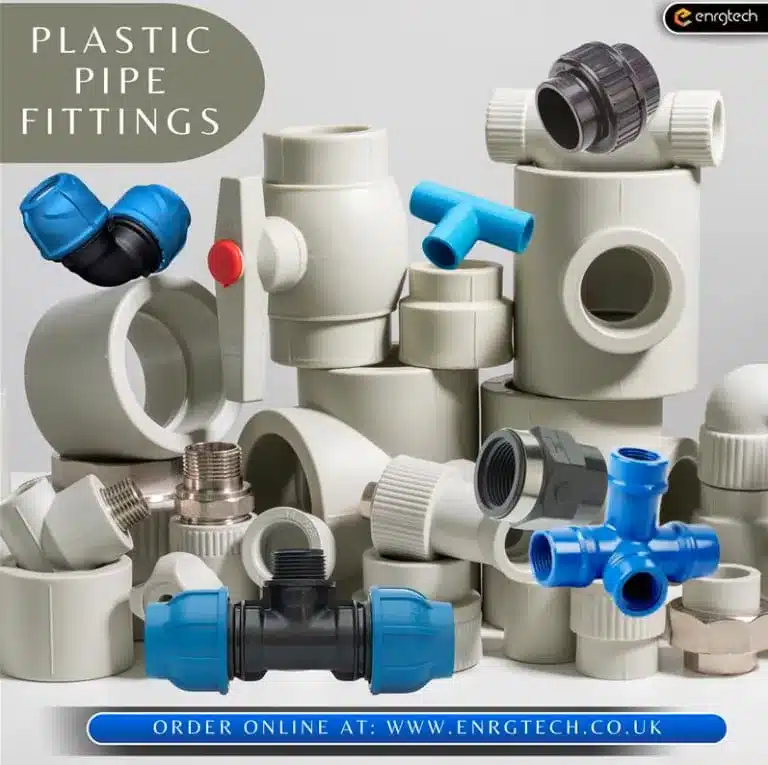
Introduction
The backbone of any plumbing or irrigation system isn’t just the pipes—it’s the fittings. Depending on the type, these components change flow direction, adapt to different sizes, and bridge different materials to ensure a leak-proof system. Understanding the different types and the functions of each is essential for both professionals and DIYers. This guide outlines the most common types and essential functions of plastic pipe fittings to help users select the right one for their needs.
What Are Plastic Pipe Fittings? Basic Definition & Materials
Plastic pipe fittings are specialised components designed to create airtight and watertight seals in various plumbing and piping networks. These fittings act as the “connective tissue” in modern fluid systems, ensuring leak-free performance. The core functionality of pipe fittings is to ensure the system can be tailored to the specific geometry of a building or machine.
The performance of these fittings is largely dictated by the thermoplastic materials from which they are made. Each material has specific properties like light weight, ease of handling, cost-efficiency, and environmental suitability. The most common varieties include:
- PVC (Polyvinyl Chloride)
- CPVC (Chlorinated Polyvinyl Chloride)
- HDPE (High Density Polyethylene)
- PPR (Polypropylene Random Copolymer)
- ABS (Acrylonitrile Butadiene Styrene).
The Significance of Plastic Pipe Fittings Over Steel Models
For decades, galvanised steel was the gold standard for plumbing. However, plastic fittings have largely overtaken steel due to several undeniable advantages:
Corrosion Resistance: Corrosion resistance is a major benefit of plastic pipe fittings. Unlike steel, plastic does not rust or degrade when exposed to water, chemicals, or humid conditions. This significantly extends the system’s lifespan and reduces maintenance costs.
Chemical Resistance: Plastic fittings offer strong chemical resistance. They perform reliably in industrial settings where corrosive fluids are present. Steel fittings often require coatings or protective treatments to withstand such environments.
Lightweight: Plastic fittings are lightweight, making transportation, storage, and installation easier. Installers can complete projects faster without heavy lifting equipment, reducing labour costs.
Smooth Internal Surfaces: Plastic fittings provide smooth internal surfaces. This minimises friction loss and improves fluid flow efficiency. Steel pipes may develop scaling or internal rust over time, restricting flow and reducing performance.
Affordable: Plastic systems are cost-effective. Due to their low corrosion resistance and easy replacement, the initial purchase cost is usually lower. Additionally, the long-term maintenance expenses are also significantly reduced.
Essential Fitting Varieties and Their Functions
To build an effective system, you need to know which “tool” to use for each turn. Here are the most common varieties:
Elbow Fittings
Elbows are one of the most frequently used plastic fittings. They are commonly available in 45° and 90° angles. Elbows are essential in plumbing, irrigation systems, and industrial piping layouts.
Functions:
- Redirect fluid flow.
- Navigate around obstacles.
- Adjust pipeline layout in tight spaces.
Tee Fittings
Tee fittings resemble the letter “T” and allow fluid to split or combine. They are available in equal and reducing tees. Tees are frequently used in water distribution and irrigation systems.
Functions:
- Branch off a main pipeline.
- Connect secondary lines.
- Distribute water or air evenly.
Couplings
Couplings are critical sleeves that permanently join two pipes. Once glued, they can not be removed without cutting the pipe. Couplings are available as standard, repair, and compression models.
Functions:
- Extend pipeline length.
- Repair damaged sections.
- Join pipe segments securely.
Reducers
Reducers are fittings that ensure a smooth transition in flow rate and pressure when moving between larger and smaller pipes. They are of two main types: concentric and eccentric. Reducers help maintain system efficiency when pipe size changes are required.
Functions:
- Adjust pipe size.
- Control flow rate.
- Connect main lines to smaller branches.
Pipe Fittings & Connection Solution
High-quality piping components engineered to provide reliable sealing, smooth flow distribution, system compatibility, and simplified maintenance.
Adapters
Adapters are the translators of the piping world. They increase the system compatibility and flexibility. Adapter fittings come in male, female, and threaded adapters.
Functions:
- Transition between pipe types.
- Connect plastic to metal fittings.
- Allow secure threaded connections.
Caps and Plugs
Caps and plugs are essential pipe fittings: caps fit over the pipe, and plugs fit inside. They are useful in testing systems or temporarily closing pipe sections.
Functions:
- Seal pipe ends.
- Allow future system expansion.
- Protect pipe interiors from debris.
Cross Fittings
Cross fittings have four openings arranged in a plus (+) shape. Because they connect four points, they can put significant structural stress on a pipe system as temperatures change. Cross fittings are commonly used in irrigation and distribution systems.
Functions:
- Create complex branching systems.
- Distribute flow evenly.
- Connect multiple pipelines.
Union Fittings
Unions function similarly to couplings but allow easy disconnection without cutting the pipe. A union fitting can be unscrewed in the middle and is designed for easy removal. These are essential near pumps or equipment that require frequent maintenance.
Functions:
- Simplify maintenance.
- Enable quick disassembly.
- Replace system components efficiently.
Final Thoughts
Plastic pipe fittings are fundamental plumbing and pipeline components built to last for decades. Their lightweight structure, affordability, smooth flow performance, and resistance features make them a practical and long-lasting alternative to traditional steel fittings. From elbows and tees to reducers and unions, each fitting serves a specific purpose in directing, connecting, or controlling flow. When chosen smartly and installed properly, these fittings offer a reliable solution for a multitude of applications.
Related posts:
 Walkie Talkies Explained: Boosting Communication and Efficiency
 The Importance of Mandrels in Metalworking and Fabrication
 Ear Protection: Top Tips and Products for Different Environments
 Paint Pens | An Ultimate Guide
 Pipe Sealants | A Complete Guide
 Microwave Detectors: Precision Tools for Detecting Microwave Emission
 Cables: How to Detect Faults in Underground Cables
 Understanding the Landscape of IoT Protocols
 What are Surface Mount Resistors and Surface Mount Technology?
 Advanced Vehicle Control Solutions with Linear Position Sensors
 New Temperature Sensor with ICs Simplify Design for Circuits
 Maximising Automation with Programmable Logic Controllers


